
The short answer
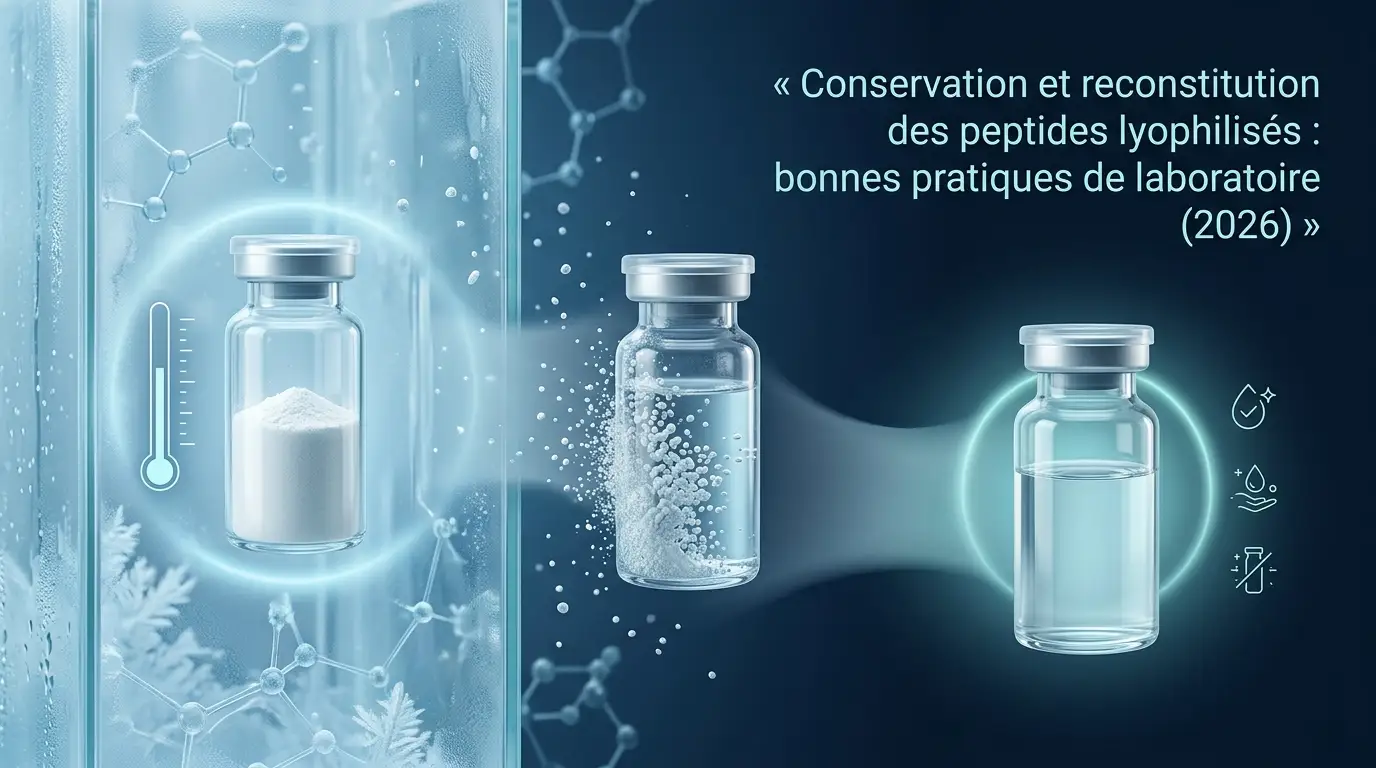
To preserve the integrity of a research peptide, follow four steps in order. One: store the lyophilizate in the freezer, protected from light and moisture, ideally below −20 °C, and let the vial reach room temperature in a desiccator before opening, because peptides are hygroscopic. Two: choose the reconstitution solvent based on the sequence — water or bacteriostatic water for readily soluble peptides, dilute acetic acid for basic peptides, a trace of organic solvent for very hydrophobic peptides. Three: calculate concentration from the mass actually present (peptide content × purity), aliquot immediately and freeze to avoid repeated freeze-thaw cycles. Four: record the reconstitution date and periodically re-test long-stored solutions by HPLC.
Regulatory framing, stated once and for all: the peptides discussed here are reagents intended exclusively for in vitro and laboratory research (Research Use Only). This article deals with handling, degradation chemistry and the preparation of study samples. It describes no administration to a human or animal, proposes no physiological dosing protocol and makes no therapeutic claim. Here, "reconstitute" means preparing a working stock solution in the laboratory.
Why are peptides lyophilized?
Lyophilization (freeze-drying) removes water from a purified peptide by sublimation, leaving an amorphous powder or film. The purpose is not cosmetic: water is the reactant or the medium of most peptide degradation reactions. By removing free water, hydrolysis of the peptide bond and deamidation — two pathways that require an aqueous environment — are drastically slowed. A peptide in solution ages over hours or days; the same peptide lyophilized and properly stored keeps for months, even years.
The literature on the stability of therapeutic proteins and peptides is explicit: lyophilized formulations show markedly reduced deamidation rates, "probably due to the limited availability of free water in which the reaction can occur." Lyophilization does not render a peptide inert — oxidation and certain solid-state reactions continue slowly — but it turns a fragile material into a storable, transportable one.
The practical consequence for the laboratory: the lyophilizate is the archival form, the solution is the working form. The whole logic of preservation is to keep the peptide dry for as long as possible, then put it into solution only at the moment of use, in fractionated amounts.
The degradation mechanisms to know
There are two broad families. Chemical instability concerns the formation or breaking of covalent bonds: hydrolysis, oxidation, deamidation. Physical instability concerns the folding and organization of molecules: denaturation, aggregation, precipitation. A single vial can undergo several pathways at once, and aqueous solution accelerates them all.
Hydrolysis cleaves the peptide chain; some bonds are especially susceptible, notably Asp–Gly and Asp–Pro. Oxidation targets electron-rich residues: methionine oxidizes to the sulfoxide then the sulfone, cysteine forms "scrambled" disulfide bridges, and tryptophan and tyrosine are also vulnerable; dissolved oxygen, light and trace metals catalyze the reaction. Deamidation converts asparagine (and more slowly glutamine) into aspartate and isoaspartate through an unstable cyclic imide intermediate, particularly above pH 5 — the Asn–Gly sequence is a classic hot spot.
Aggregation, finally, is a major physical pathway: mechanical stress (vigorous agitation, vortexing, pipetting at air-liquid interfaces) exposes hydrophobic regions that associate into soluble then insoluble aggregates. Freezing itself can concentrate the peptide by ice exclusion (a "salting-out" effect) and promote precipitation that is not fully reversible on thawing. Knowing the sequence — the presence of Met, Cys, Trp, Asn, Gln, or Asp–Gly bonds — lets you anticipate the dominant degradation pathway and tailor storage accordingly.
Storing the lyophilizate: temperature, light, moisture
Temperature is the first lever. For short-term storage, the refrigerator (4 °C) may suffice, but for the medium and long term the technical guides of academic suppliers recommend the freezer: below −20 °C at minimum, and −50 °C or lower for extended archiving. Cold slows every degradation kinetic. Peptides containing sensitive residues (Met, Cys, Trp, Asn, Gln) are the most demanding on this point.
Moisture is the silent enemy. Lyophilized peptides are hygroscopic: they capture water from ambient air as soon as a cold vial is opened, because condensation forms on the walls. The rule is therefore always to let the vial return to room temperature in a desiccator before opening and weighing. This absorbed water not only lowers the real peptide content; it locally restarts the hydrolysis and deamidation reactions that lyophilization had suspended.
Light and oxygen complete the picture: store away from light (amber vial or opaque box) to limit photo-oxidation, and minimize exposure to air. Finally, avoid freeze-thaw cycles of the lyophilizate itself: taking a whole vial out of the freezer, letting it warm, reopening it and refreezing it several times multiplies the opportunities for condensation. Better to fraction the powder in a single operation or, more often, to aliquot after reconstitution.
Choosing the reconstitution solvent by sequence
There is no universal solvent: the right choice depends on the peptide's net charge and hydrophobicity, both read from the sequence. The guiding principle is acid-base: a peptide dissolves best in a solvent whose acidic or basic character is opposite to its own. Always start by testing dissolution on a small fraction before treating the whole vial.
Basic peptides (rich in Arg, Lys, His) dissolve well in a mildly acidic medium: dilute acetic acid (for example 0.1 to 1%) or a trace of trifluoroacetic acid, before diluting in water or buffer. Acidic peptides (rich in Asp, Glu) prefer a very dilute base, such as 0.1% aqueous ammonia, followed by dilution. Neutral, well-balanced peptides most often dissolve directly in water. Very hydrophobic peptides first require a small amount of organic solvent — DMSO, DMF, acetonitrile — before aqueous dilution.
Two chemical safeguards apply. DMSO must be avoided for peptides containing methionine or free cysteine: it promotes oxidation of thiols and thioethers. And for any peptide rich in Cys, Met or Trp, degassed, oxygen-free solvents are preferred, optionally with a reducing agent, because thiols oxidize rapidly to disulfides once the pH exceeds 7. The solvent is never neutral with respect to stability: it is part of the preservation protocol.
Bacteriostatic water, sterile water, dilute acetic acid
Bacteriostatic water is sterile water with 0.9% (w/v) benzyl alcohol added, a preservative that inhibits microbial growth without strictly sterilizing. This bacteriostatic effect allows repeated withdrawals from a single multi-dose vial, as long as aseptic technique is maintained — an obvious practical advantage when preparing and fractionating stock solutions in the laboratory over several days.
Sterile water for preparation contains no preservative: it suits single use, since the risk of contamination rises from the first opening. Dilute acetic acid plays a different role: it is a solubilizing solvent, useful for hydrophobic or basic sequences and for stabilizing certain peptides at slightly acidic pH, but it must be diluted before many in vitro cell assays. These three liquids answer three distinct needs and are not interchangeable without thought.
The choice is therefore reasoned by crossing two criteria: the solubility imposed by the sequence, and the intended lifetime of the stock solution. A solution meant to be fractionated and reopened several times benefits from the bacteriostatic character; a single-use solution reconstituted then immediately aliquoted and frozen does not carry the same constraint. In all cases, benzyl alcohol remains an additive to document in the experimental protocol.
Reconstituting cleanly and calculating concentration
Reconstitution is done gently. Let the solvent run down the vial wall rather than directly onto the powder, then dissolve by slow rotation or inversion — never with an aggressive vortex or prolonged sonication, which expose hydrophobic regions and promote aggregation. Incomplete dissolution, persistent cloudiness or a deposit signal that the solvent should be adjusted rather than forced mechanically.
Concentration calculation must start from the mass actually present, not the figure printed on the label. The effective amount of peptide is the product of nominal mass, peptide content and purity: a vial labeled 10 mg may contain only 7 to 9 mg of net peptide, the rest being bound water, salts and the TFA counterion. Concentration = net peptide mass ÷ volume of solvent added. To avoid conversion errors (mg, mcg, mL, mmol/L), the safest route is the site's reconstitution calculator, which links volume, mass and target concentration.
Finally, document each stock solution: peptide, batch, solvent, calculated concentration, date and time of reconstitution. This traceability, mundane in appearance, is what later allows you to interpret a drift in results or to decide that a solution has passed its window of reliability.
Solution stability, aliquoting and freeze-thaw cycles
Once in solution, the degradation countdown resumes. The general rule is therefore to reconstitute only what you need and to aliquot the rest immediately, in portions sized for a single use. Each aliquot then undergoes only one freeze-thaw cycle, instead of the whole stock solution being mistreated repeatedly.
Repeated freeze-thaw cycles are one of the most underestimated causes of degradation. At each freezing, ice-crystal formation concentrates the peptide and locally alters pH and ionic strength; at each thawing, interfaces and mechanical stress promote aggregation. Two or three cycles can be enough to visibly alter sensitive peptides. Aliquoting removes the problem at its root: you thaw only one tube, only once.
For solution storage, the guides recommend freezing below −15 °C and avoiding prolonged storage in liquid form, especially for peptides with sensitive residues. Concentrated organic solutions (for example in DMSO) sometimes keep better than aqueous ones, but remain incompatible with many biological systems at high concentration and must be diluted at the point of use. In short: dry and cold for the archive, frozen aliquots for the work, final dilution at the last minute.
Quality control over time and common mistakes
Preservation is not a single act but a state to verify. For long-archived batches or stock solutions kept for several weeks, a periodic re-test by reversed-phase HPLC lets you compare the current profile with the original chromatogram: the appearance of new peaks, broadening or splitting of the main peak, or a drop in its relative area signal degradation. Mass spectrometry can confirm an oxidation (a +16 Da gain per oxygen atom on a methionine) or a deamidation (+1 Da). This re-test turns an intuition into data.
The most frequent laboratory mistakes are avoidable. Opening a cold vial without letting it reach room temperature condenses water onto the powder. Aggressive vortexing or sonication aggregates fragile peptides. Using DMSO on a methionine- or cysteine-containing peptide causes avoidable oxidation. Calculating concentration from the label mass rather than the net mass overestimates the titer by 10 to 30%. Multiplying freeze-thaw cycles of the stock solution instead of aliquoting slowly degrades the entire stock.
Good practice therefore comes down to one coherent chain: store dry, cold and in the dark; temper before opening; choose the solvent from the sequence; reconstitute gently; calculate on the net mass; aliquot and freeze; document; and re-test before any critical use. None of these steps is costly, but each one, if neglected, can silently invalidate an experiment — which, in research, costs far more than rigor.
Sources
- Bachem — Handling and Storage Guidelines for Peptides (temperature, hygroscopicity, solvents by sequence type)
- Bachem — Peptide Solubility (solvent choice from the acid-base properties of the sequence)
- Merck / Sigma-Aldrich — Solubility Guidelines for Peptides (dissolution test, DMSO and sensitive residues)
- BioProcess International — Stability Considerations for Biopharmaceuticals: Protein and Peptide Degradation Pathways
- Manning MC, Chou DK, Murphy BM, Payne RW, Katayama DS — Stability of Protein Pharmaceuticals: An Update, Pharm Res 27 (2010)
- MDPI Encyclopedia — Instability of Peptide and Possible Causes of Degradation (hydrolysis, oxidation, deamidation, aggregation)