
The short answer
GHK-Cu (glycyl-L-histidyl-L-lysine complexed with copper) and AHK-Cu (alanyl-L-histidyl-L-lysine complexed with copper) are two tripeptides capable of binding a copper(II) ion. The first is a molecule naturally present in human plasma, discovered in 1973 by the biochemist Loren Pickart; the second is a closely related synthetic analogue, studied mainly in the context of the hair follicle. Both are backed by a genuine body of literature, but the overwhelming majority of it consists of in vitro and animal work.
What the research documents best for GHK-Cu: stimulation of collagen synthesis by cultured fibroblasts, modulation of extracellular matrix remodelling enzymes, effects on wound healing in animal models, and modulation of the expression of many human genes. For AHK-Cu, the literature essentially comes down to in vitro work on dermal papilla cells and cultured human hair follicles.
What the research does not document: large, randomised, controlled and independent clinical trials in humans. The available facial studies are few, often funded by cosmetic manufacturers and rarely published in peer-reviewed journals. This article reports the state of the literature; it is neither medical advice nor a claim of cosmetic or therapeutic efficacy.
1973: Loren Pickart’s discovery
The GHK story begins in a biochemistry laboratory at the University of California, San Francisco. In 1973, Loren Pickart and Marvin Thaler published an intriguing observation in Nature New Biology: a fraction of human serum prolonged the survival of normal liver cells in culture. The active factor was identified as a tripeptide, glycyl-L-histidyl-L-lysine, present at concentrations in the nanogram-per-millilitre range in plasma.
Pickart’s subsequent work showed that this tripeptide circulates largely complexed with copper(II), hence the name GHK-Cu. A frequently cited figure from his publications is the decline in plasma concentration with age, from roughly 200 ng/mL around age 20 to roughly 80 ng/mL around age 60. This correlation fuelled the hypothesis of a role in tissue maintenance, but correlation does not establish causation, and this point remains a working hypothesis.
One piece of context: Loren Pickart, who died in 2022, founded companies that commercialised this molecule and co-authored the majority of review articles on GHK-Cu. This does not invalidate data partly replicated by other groups, but it is a potential bias that any critical reading should keep in mind.
The chemistry of a peptide-copper complex
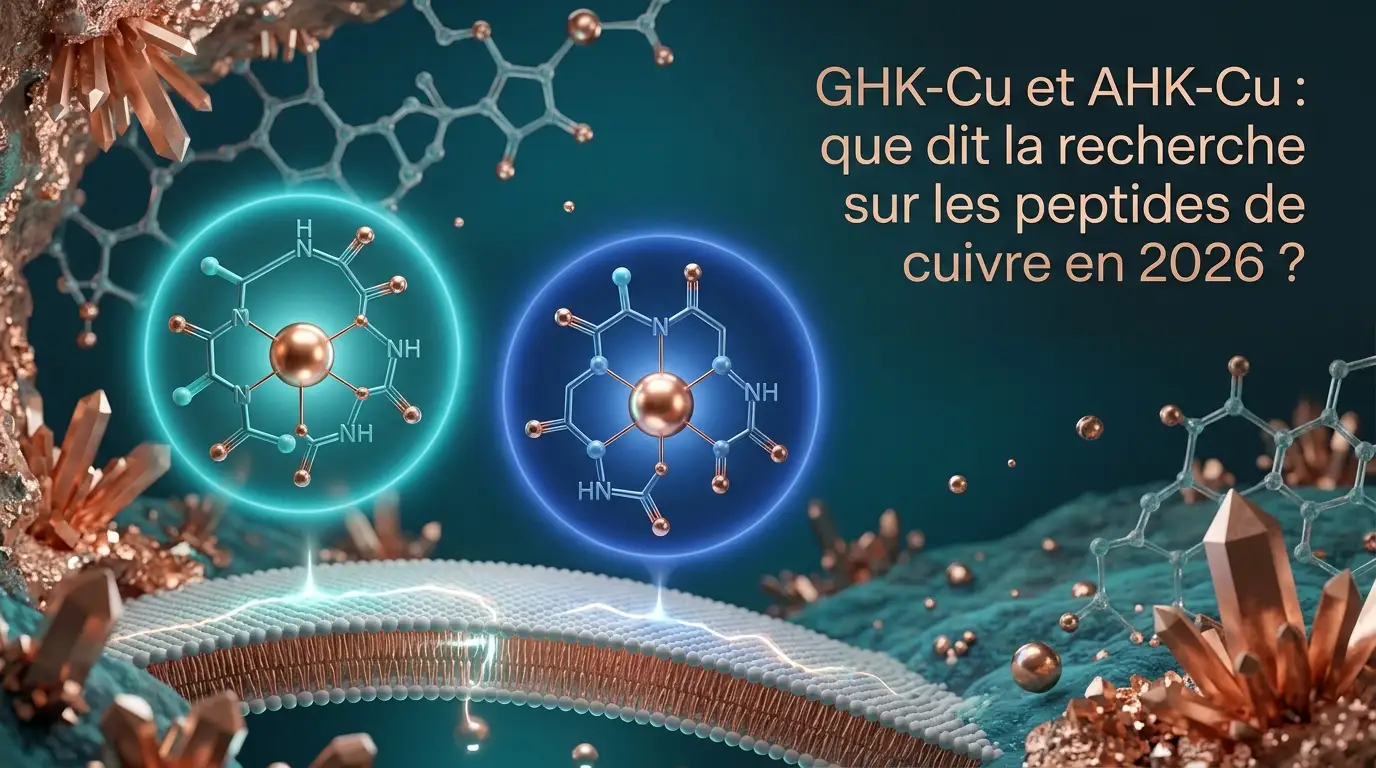
GHK is a very small peptide, three amino acids, around 340 daltons in its free form. Its distinctive feature is a high affinity for the copper(II) ion: coordination involves the amino group of glycine, the nitrogen of the peptide bond and the imidazole ring of histidine, forming a stable complex with a slightly distorted square-planar geometry. The lysine side chain remains free, which could allow it to interact with other molecular partners.
This architecture makes GHK-Cu a candidate copper carrier. Copper is an essential cofactor of key enzymes in connective tissue biology, such as lysyl oxidase, which is indispensable for cross-linking collagen and elastin, and Cu/Zn superoxide dismutase. The prevailing hypothesis in the literature is that GHK-Cu may facilitate copper exchange with proteins such as albumin and contribute to its cellular distribution, while also exerting signalling effects of its own.
Extracellular matrix and collagen: the foundational data
The study that launched dermatological interest in GHK-Cu dates from 1988: François-Xavier Maquart and colleagues in Reims showed in FEBS Letters that the complex stimulates collagen synthesis by cultured human fibroblasts, with an effect observed at remarkably low concentrations, in the picomolar to nanomolar range. This extreme sensitivity is one of the peptide’s signatures in the literature.
Subsequent work by the same group and other teams broadened the picture: stimulation of the synthesis of glycosaminoglycans and proteoglycans such as decorin, but also increased expression of the metalloproteinase MMP-2 and its tissue inhibitors (TIMP-1 and TIMP-2) in fibroblast cultures, as shown by Siméon’s team in 2000. Hence the description of GHK-Cu as a modulator of matrix remodelling rather than a simple collagen booster.
It bears repeating: these results come from cell cultures. They establish a real and reproducible biological activity in vitro, which is not nothing, but they do not tell us what the molecule would do in intact human skin, with its barriers, its pharmacokinetics and its tissue complexity.
Gene expression: a broad-spectrum modulator
One of the most interesting developments in recent GHK research came from genomics. Analyses run with the Broad Institute’s Connectivity Map tool, reported in the reviews by Pickart and Margolina, suggest that GHK alters the expression of a substantial percentage of the human genes tested, with profiles interpreted as a shift toward a transcriptional state associated with tissue health. These analyses remain exploratory and their interpretations should be read with caution, but they gave the peptide new visibility in systems biology.
An independent and methodologically solid illustration is the study by Campbell and colleagues published in Genome Medicine in 2012. Searching for molecules capable of reversing the transcriptomic signature of emphysematous lung destruction, the authors identified GHK through computational screening, then showed that it restored collagen remodelling functions in vitro in lung fibroblasts from COPD patients. This study, unrelated to cosmetics, is one of the rare pieces of GHK research to emerge from an independent academic consortium.
Wound healing, skin and hair: the preclinical corpus
Pickart’s 2008 review in the Journal of Biomaterials Science and the 2015 review in BioMed Research International compile the bulk of the preclinical corpus: in rats, rabbits, pigs and dogs, GHK-Cu incorporated into dressings or gels has been associated with accelerated wound contraction, better vascularisation of granulation tissue and increased local antioxidants. Angiogenesis, the formation of new capillaries, recurs as a central theme in these models.
On the hair follicle side, older work, notably by Uno and Kurata in the 1990s, reported that a GHK-Cu analogue increased follicle size and stimulated follicle growth in animal models. It is this thread that led industry to take an interest in peptide-copper derivatives for hair research, and that connects to AHK-Cu.
For human skin, a few studies of cosmetic formulations containing GHK-Cu have reported improvements in parameters such as apparent dermal density or the appearance of wrinkles. These studies are cited in Pickart’s reviews, but most were presented at conferences or funded by manufacturers, with small sample sizes and no full publication in peer-reviewed journals. As they stand, they are preliminary indications rather than proof.
AHK-Cu: what the hair research says
The published literature on AHK-Cu is surprisingly thin given its commercial fame. The central reference is the study by Pyo and colleagues, published in 2007 in Archives of Pharmacal Research: in cultured human hair follicles and dermal papilla cells, the AHK-Cu complex stimulated hair shaft elongation and dermal papilla cell proliferation, with increased expression of VEGF, a pro-angiogenic factor, and decreased pro-apoptotic markers.
The link often drawn with DHT (dihydrotestosterone), the androgen at the centre of androgenetic alopecia, deserves clarification. The hypothesis that peptide-copper complexes inhibit 5-alpha-reductase circulates in secondary literature and marketing material, but it rests on very little published primary data and is not among the demonstrated results of the Pyo study. On the basis of accessible publications, it is a speculative lead, not an established mechanism.
No published randomised clinical trial has evaluated AHK-Cu alone in humans. The available data describe a plausible biological effect on the cultured follicle, full stop. This contrast between the thinness of the scientific file and the abundance of marketing copy is precisely what an informed reader should watch for.
GHK-Cu versus AHK-Cu: what are the differences?
Structurally, a single amino acid separates them: glycine in position 1 for GHK, alanine for AHK, with histidine and lysine conserved, along with the copper coordination mode. On paper, they are two very close members of the same chemical family.
Scientifically, however, the gap is considerable. GHK-Cu is an endogenous human molecule documented by several hundred publications spanning five decades, covering the extracellular matrix, wound healing, gene expression, the lung, the nervous system and the skin. AHK-Cu is a synthetic analogue whose primary literature can be counted on one hand, almost exclusively focused on the hair follicle in vitro. Comparing the two files as if they were equivalent would be misleading.
In laboratory practice, the two complexes share similar handling characteristics: small size, aqueous solubility, and sensitivity of the peptide-copper equilibrium to pH and to chelators present in media. For comparative research work, peptide purity and copper stoichiometry are critical parameters to check on the certificate of analysis.
Topical cosmetics and research peptide: two distinct statuses
A factual point that causes frequent confusion: the copper tripeptide exists under two very different regulatory statuses. Under the INCI name Copper Tripeptide-1, GHK-Cu has been a cosmetic ingredient used since the 1990s in creams and serums, governed in Europe by the Cosmetics Regulation (EC) No 1223/2009, which requires a safety assessment of the finished formulation but does not demand pharmaceutical-grade proof of efficacy.
The research peptide sold by reagent suppliers falls under an entirely different framework: it is a chemical product intended exclusively for in vitro research (Research Use Only), which is neither a cosmetic, nor a medicine, nor a supplement, and which is not intended for human or animal administration in any form. The presence of a related ingredient in commercial cosmetics changes nothing about the status of the laboratory reagent.
This distinction also explains part of the literature: cosmetic studies evaluate complex formulations, at particular concentrations and with specific penetration systems, and their results say nothing about the isolated molecule, just as in vitro data on the isolated molecule do not validate any given cream.
Limitations of the data and current research directions
The limitations of the copper peptide file are easy to identify. One, the scarcity of published randomised controlled trials: for topical GHK-Cu, the few facial studies cited are old, small and mostly sponsored; for AHK-Cu, there are none. Two, the concentration of review articles around one author with commercial interests in the molecule. Three, the heterogeneity of models, concentrations and formulations, which precludes any serious meta-analysis. Four, the unresolved question of how a charged, hydrophilic complex penetrates the stratum corneum barrier.
Current research directions reflect these issues. Recent literature includes work on delivery systems (microneedles, liposomes, nanoparticles) designed to bypass the skin barrier, tissue engineering applications in which GHK is grafted onto biomaterials and hydrogels for regeneration models, and the continuation of the transcriptomic exploration opened by the COPD study, which treats GHK as a pharmacological probe of tissue remodelling.
In summary: copper peptides rest on a real, long-standing and partly replicated in vitro and preclinical base, which sets them apart from many fashionable molecules. But the independent clinical step has never been taken, and any claim of efficacy in humans currently exceeds what the published data allow. That is exactly where the line between research and marketing lies.
Sources
- Pickart L, Thaler MM. Tripeptide in human serum which prolongs survival of normal liver cells. Nature New Biology, 1973
- Maquart FX, et al. Stimulation of collagen synthesis in fibroblast cultures by the tripeptide-copper complex GHK-Cu2+. FEBS Letters, 1988 (PubMed)
- Siméon A, et al. GHK-Cu2+ stimulates matrix metalloproteinase-2 expression by fibroblast cultures. FEBS Letters, 2000 (PubMed)
- Pyo HK, et al. The effect of tripeptide-copper complex on human hair growth in vitro. Archives of Pharmacal Research, 2007
- Pickart L. The human tri-peptide GHK and tissue remodeling. Journal of Biomaterials Science, Polymer Edition, 2008 (PubMed)
- Campbell JD, et al. A gene expression signature of emphysema-related lung destruction and its reversal by the tripeptide GHK. Genome Medicine, 2012 (PubMed)
- Pickart L, Vasquez-Soltero JM, Margolina A. GHK Peptide as a Natural Modulator of Multiple Cellular Pathways in Skin Regeneration. BioMed Research International, 2015 (PubMed)
- Pickart L, Margolina A. Regenerative and Protective Actions of the GHK-Cu Peptide in the Light of the New Gene Data. International Journal of Molecular Sciences, 2018 (PubMed)