
The short answer
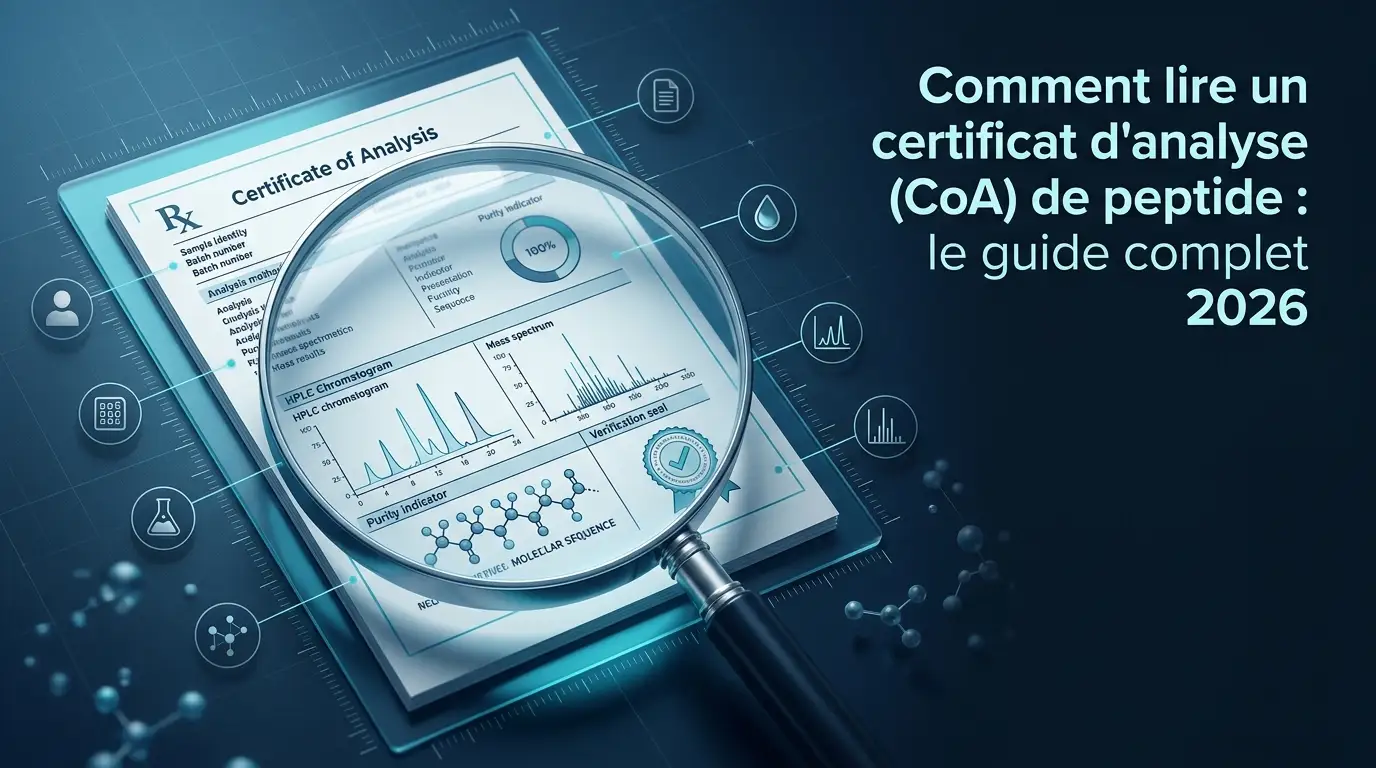
To evaluate a peptide certificate of analysis (CoA), ask four questions in order. One: does the document match your vial exactly (peptide name, batch number, analysis date)? Two: is identity confirmed by mass spectrometry, with an observed mass consistent with the theoretical mass of the sequence? Three: is the HPLC purity figure presented together with its chromatogram, rather than as an isolated percentage? Four: are the relevant complementary tests (peptide content, water content, TFA counterion, endotoxins where applicable) included, or at least available on request?
If these four points are satisfied — ideally with testing performed or cross-checked by an identified third-party laboratory — the CoA does its job: objectively documenting what the batch contains. If one is missing, the document loses most of its evidentiary value. A framing reminder: the peptides discussed here are reagents intended exclusively for in vitro and laboratory research (Research Use Only); a CoA describes a study material and in no way constitutes validation for any use in humans or animals.
What is a CoA and why is it central to research?
A certificate of analysis is a document issued for one specific production batch, compiling the results of analytical tests performed on that batch: identity, purity and, depending on the case, peptide content, water content, synthesis residues or endotoxin load. It turns a commercial claim (“99% pure peptide”) into verifiable data tied to a method, an instrument, a date and a signatory.
In research, this traceability underpins reproducibility. Two batches of the same peptide can differ in their impurity profile or their actual peptide content; without a CoA, there is no way to know whether a change in experimental results comes from the protocol or from the material. The regulatory frameworks applied to therapeutic peptides — pharmacopoeias and ICH guidelines — are built on exactly this batch-by-batch characterisation logic, and they provide a useful reading grid even for laboratory reagents.
Anatomy of a CoA: batch, supplier, laboratory
A serious CoA starts with a complete identity card: peptide name and sequence (or an unambiguous catalogue reference), formula and theoretical molecular mass, unique batch number, nominal quantity, manufacturing or release date, analysis date, and storage conditions. The batch number is the keystone: it must be identical on the vial, on the certificate and in the supplier’s records.
The document must then identify who analysed what. If the supplier runs its tests in-house, the CoA should say so. If a third-party laboratory is involved, its name must appear, along with the method used for each test. A well-built specification table has three columns: the test (for example “HPLC purity”), the acceptance criterion (“≥ 98%”) and the measured result (“99.1%”). The absence of acceptance criteria — results only — is already a sign of weaker rigour.
HPLC explained simply
High-performance liquid chromatography (HPLC), most often reversed-phase (RP-HPLC) for peptides, separates the molecules in a sample according to their hydrophobicity. The sample is pushed under pressure through a column; each species exits at a different moment (its retention time) and passes a UV detector, usually set around 214-220 nm, the wavelength at which the peptide bond absorbs. The output is a chromatogram: a curve with peaks.
The main peak corresponds to the target peptide; secondary peaks are impurities, typically truncated sequences, deletion products or chemically modified forms arising from synthesis. The purity percentage is calculated by dividing the area of the main peak by the total area of all peaks. A 99% purity therefore means the main peak accounts for 99% of the total UV-detected area — no more, no less.
In practice, check three things on the chromatogram: a sharp, symmetrical main peak, a clean baseline, and consistency between the stated percentage and what the curve actually shows. A broadened or split main peak surrounded by numerous shoulders tells a different story from the number on the page.
What a chromatogram shows — and does not show
HPLC purity is a relative measurement, limited to what the detector sees. It says nothing about compounds that absorb little or no UV at the chosen wavelength: residual water, salts, counterions such as TFA. It can also underestimate impurities that co-elute with the main peak — that is, leave the column at exactly the same moment and hide under the same peak.
Above all, HPLC alone does not prove identity. A single beautiful peak can belong to a molecule that is not the expected peptide: the column separates, it does not identify. That is why a credible CoA always pairs chromatographic purity with an independent identity confirmation, almost always by mass spectrometry. A certificate showing purity without documented identity is incomplete by construction.
Mass spectrometry: confirming identity
Mass spectrometry (MS) measures the mass-to-charge ratio of ionised molecules, most often by electrospray (ESI-MS) or MALDI-TOF for peptides. From the amino acid sequence, a theoretical mass is calculated; the instrument provides the observed mass. If the two agree within the accuracy of the instrument (typically from a fraction of a mass unit down to a few decimal places depending on the technology), the identity of the main molecule is confirmed. This is the reference method for verifying that a synthetic peptide is indeed what it is claimed to be.
On the CoA, look for the two values side by side: theoretical (calculated) mass and observed (measured) mass, together with the technique used. Watch for reading subtleties: ESI spectra often display multiply charged species ([M+2H]2+, [M+3H]3+), and the mass can be expressed as monoisotopic or average — two different conventions that explain small apparent discrepancies. A genuine, unexplained gap of several mass units, on the other hand, suggests a sequence error, a chemical modification or the wrong product.
Remember the formula: HPLC tells you “how pure it is”, MS tells you “what it is”. Purity and identity are orthogonal pieces of information; a batch can be 99% pure and still be the wrong peptide. The two measurements together, on the same batch, form the minimum foundation of a usable CoA.
Peptide content, water and TFA: the classic trap
Here is the most frequent trap when reading a CoA: confusing purity with peptide content. HPLC purity compares the target peptide with the other UV-detected species. Peptide content measures what fraction of the total mass of the powder is actually peptide — as opposed to water, salts and counterions. A lyophilisate of 99% pure peptide may well contain only 70 to 90% peptide by mass, the remainder being bound water and TFA. Both figures are true at the same time.
TFA (trifluoroacetic acid) is used during preparative HPLC purification and stays associated with the peptide as the counterion of basic groups; lyophilised peptides are also hygroscopic and retain water. Peptide content is determined by amino acid analysis (AAA) or elemental nitrogen analysis, and appears on the most complete CoAs, sometimes alongside a water content (Karl Fischer) and a residual TFA assay.
For quantitative laboratory work, this distinction is decisive: the real amount of peptide in a vial is the product of peptide content and purity, not the mass printed on the label. Ignoring this point leads to concentrations overestimated by 10 to 30% when preparing study solutions.
Endotoxins, sterility and complementary tests
Some research applications — cell culture, assays sensitive to bacterial contaminants — justify additional testing. The most common is bacterial endotoxin testing, performed with the LAL assay (Limulus amebocyte lysate) following the principles of USP chapter <85> and its European Pharmacopoeia counterpart, with results expressed in endotoxin units (EU) per milligram. A sterility or bioburden test may be added for certain formats.
These tests are not systematic for RUO reagents, and their absence is not disqualifying in itself: it all depends on the intended experimental use. The right reflex is to check what the CoA actually covers, and what the supplier can provide on request for a given batch. A transparent supplier states clearly which tests are run routinely, which are optional, and who performs them.
Red flags of a dubious CoA
Some defects should immediately raise suspicion. A generic document with no batch number, or whose batch does not match the vial received, certifies nothing. An unidentified testing laboratory (no name, no address, no signature) makes the result unverifiable. A spectacular purity — “99.9%” — claimed without a chromatogram or analysis conditions is an assertion, not a measurement. Inconsistent dates (analysis predating manufacture, a certificate dated in the future, the same analysis date across dozens of different batches) betray a recycled document.
Other signals are more subtle: a blurry, cropped chromatogram image on which neither the axes nor the integration can be read; an observed mass strictly identical to the theoretical mass, to every decimal place, on every batch; the complete absence of acceptance criteria; the same PDF file reused for different peptides. None of these clues proves fraud on its own, but their accumulation sketches a decorative rather than analytical document. When in doubt, ask for the raw data: a serious supplier can produce it, an opaque reseller cannot.
Independent third-party testing and final checklist
Testing by an independent third-party laboratory is the best corrective for the structural conflict of interest in any CoA: the party selling is the party certifying. An external, identified laboratory with no ownership ties to the supplier, receiving a coded sample of the batch and publishing its own chromatograms and spectra, provides a level of confidence no self-declaration can match. Spot cross-testing by the buyer — having a critical batch tested yourself — also remains possible and is good practice for sensitive work.
Verification checklist before using a batch in research: 1) the peptide name and batch number on the CoA match the vial exactly; 2) the observed mass from mass spectrometry is consistent with the theoretical mass of the sequence; 3) the HPLC purity percentage comes with its chromatogram and a sharp main peak; 4) the method of each test is named (RP-HPLC, ESI-MS, AAA, LAL...); 5) the testing laboratory is identified, ideally third-party and independent; 6) the dates (manufacture, analysis, issue) are mutually consistent; 7) peptide content, water content and TFA are reported or available if your use is quantitative; 8) endotoxins are documented if your application requires it; 9) acceptance criteria appear next to the results; 10) the supplier can provide raw data on request.
A well-built CoA does not by itself guarantee the quality of a batch, but it makes quality verifiable — which is exactly what an honest scientific approach demands. Taking five minutes to read it with this grid is one of the best time investments a laboratory can make before committing weeks of experiments to uncertain material.
Sources
- Merck / Sigma-Aldrich — Peptide Sample Amount Determination (purity vs peptide content, AAA)
- Iris Biotech — Net Content and Purity, Two Key Parameters in Peptide Synthesis
- Chrone VG, Lorentzen A, Højrup P — Characterization of Synthetic Peptides by Mass Spectrometry, Methods Mol Biol 2821 (2024)
- Elsayed et al. — Regulatory Guidelines for the Analysis of Therapeutic Peptides and Proteins, Journal of Peptide Science (2025)
- Sievers (Veolia) — USP <85> Bacterial Endotoxins Test: LAL methods and requirements